Silicon anodes: what if sodium goes in first?

Updated: Oct 15
Most lithium-ion batteries sold today use graphite as the anode. Graphite stores lithium between its carbon layers, and it needs six carbon atoms for each lithium atom. This gives a capacity of about 372 mAh/g.
Silicon (Si) works differently. It forms alloys with lithium, and each Si atom can take more than four Li atoms. Its theoretical capacity is 4200 mAh/g, about ten times that of graphite. Silicon is also the second most abundant element in the Earth's crust.
So why is the anode in your phone not made of silicon?
Where is the problem?
The problem is the volume. When silicon takes that much lithium, its volume changes by more than 300%, and during discharge it shrinks again. After a few cycles the particles crack and pulverize, and the pieces lose electrical contact with the current collector.
There is a second problem. The surface of the anode is covered by a thin layer formed from decomposed electrolyte, the solid electrolyte interphase (SEI). A good SEI is dense and stable. On silicon, each crack exposes fresh surface, new SEI forms on it, and this consumes lithium that does not come back.
These two effects are the main reasons why the capacity of a silicon anode fades with cycling.
What has been tried?
Most strategies make the silicon small: nanoparticles, nanowires, thin films or microwires. Small structures tolerate the strain better.
Another strategy is preconditioning. The anode is lithiated and delithiated very slowly before normal use, for example in 10 h. This leaves pores inside the silicon, and the pores help lithium move in the following cycles.
What did I do in my Ph.D.?
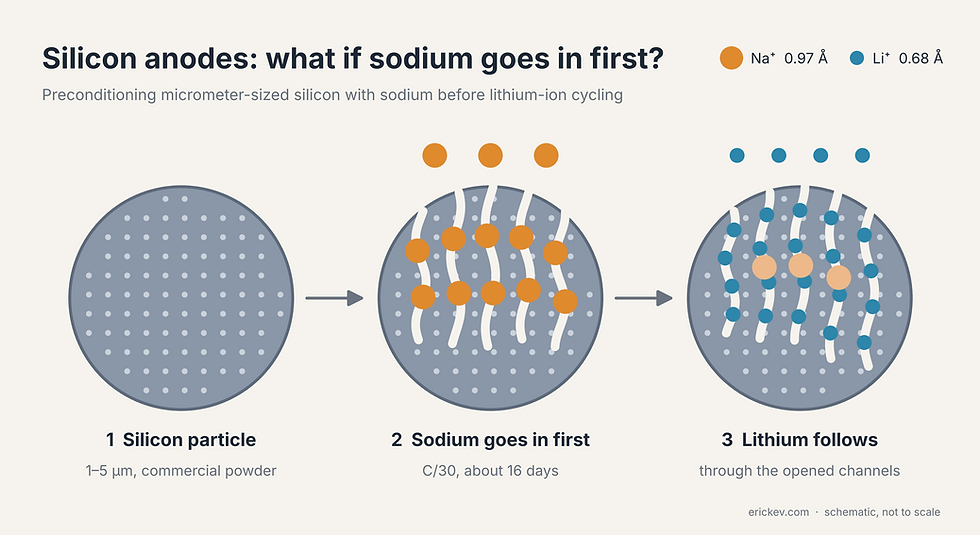
My thesis, at the Institute of Physics of BUAP with Dr. Enrique Quiroga-González, asked a simple question. What if the preconditioning is done with sodium instead of lithium?
The sodium ion is larger than the lithium ion (0.97 Å against 0.68 Å). If sodium opens channels in the silicon first, lithium should move through them more easily afterwards.
There was a reason to doubt it. Several studies say that sodium only enters silicon when the particles are nanometer-sized. We used commercial powder with particles of 1–5 µm, and we were very patient. At a rate of C/30, one sodiation and desodiation cycle lasted 190 h. The two cycles of the treatment took about 16 days.
Synchrotron X-ray diffraction at SSRL confirmed that Na–Si phases had formed. Sodium does enter micrometer-sized silicon when it is given enough time.
Did it help?
In part. The sodium-preconditioned anodes delivered less capacity than the untreated ones, but they lost it more slowly. At a rate of C/2, the capacity of the untreated anode fell about three times faster per cycle. An anode preconditioned with lithium was in between.
The sodium-preconditioned anode gave about 532 mAh/g at C/2. This is above graphite, but far from the theoretical value of silicon. X-ray diffraction during lithiation also showed that the most lithiated phases, Li₁₅Si₄ and Li₂₂Si₅, formed more easily after the treatment.
In the same project we used impedance spectroscopy to follow the SEI on silicon. We found that it forms as two layers, which merge into one after many cycles. That is the subject of our 2021 paper and of another post.
What is left to do?
The capacity is still low, and 16 days of preconditioning is not practical. But the result shows that micrometer-sized silicon, which is easier to process than nanostructured silicon, should not be discarded.
The same idea could be tried on microstructured silicon and Si–C composites, or in the other direction, for sodium-ion batteries.
Full Paper: E. L. Espinosa Villatoro, "Effect of preconditioning silicon anodes by sodiation and their performance in lithium ion batteries", Ph.D. thesis, BUAP (2021). E. Espinosa-Villatoro, J. Nelson Weker, J. S. Ko, E. Quiroga-González, Journal of Electroanalytical Chemistry 892 (2021) 115309. DOI: 10.1016/j.jelechem.2021.115309


Comments